Draft Survey Errors That Trigger Cargo Shortage Disputes in Brazil (and How to Prevent Them)
Draft & Cargo Measurement
—
Dec 11, 2025
Introduction
Draft surveys remain one of the most practical methods to determine bulk cargo quantity when shore scales are unavailable, disputed, or not contractually accepted. In Brazil, draft survey figures are often used to frame shortage discussions between owners, charterers, terminals and receivers—especially in grains, fertilizers, coal and mineral trades.
Shortage disputes rarely stem from a single “big mistake.” More often, they are driven by small technical errors that compound: an incorrect draft reading, a poorly documented correction, an unreliable density input, or inconsistent assumptions in the calculation sheet. When the survey record is incomplete or unclear, the figures become easier to challenge.
This article sets out the most common draft survey errors seen in practice and the controls that prevent them.
1) Draft Reading Errors
Accurate draft readings are foundational. Even small reading deviations can translate into large tonnage differences on deep-draft bulk carriers.
Common issues include:
Reading drafts from an incorrect angle (parallax)
Misidentifying the mark due to paint wear, fouling, or poor illumination
Using an average reading without recording fore/aft/port/starboard separately
Not accounting for swell, surge or passing traffic affecting the waterline
Good practice requires multiple readings, clear notation of sea state, and consistency checks between sides.
2) Trim and List Not Properly Captured
Draft surveys depend on correct evaluation of trim and list. Errors here may distort the hydrostatic inputs used to determine displacement.
Typical failures:
Assuming “almost even keel” without measuring properly
Ignoring small list angles that affect mean draft
Not recording how the mean draft was derived
Using hydrostatic tables outside their valid range
A defensible draft survey explicitly records trim, list, and the method used to obtain corrected mean drafts.
3) Incorrect Density and Water Condition Assumptions
Density is a high-sensitivity input. In Brazilian ports, density can vary due to river influence, rainfall, tide cycles, and mixed water layers.
Common problems include:
Using “standard” densities rather than measured samples
Taking a single density reading in stratified water conditions
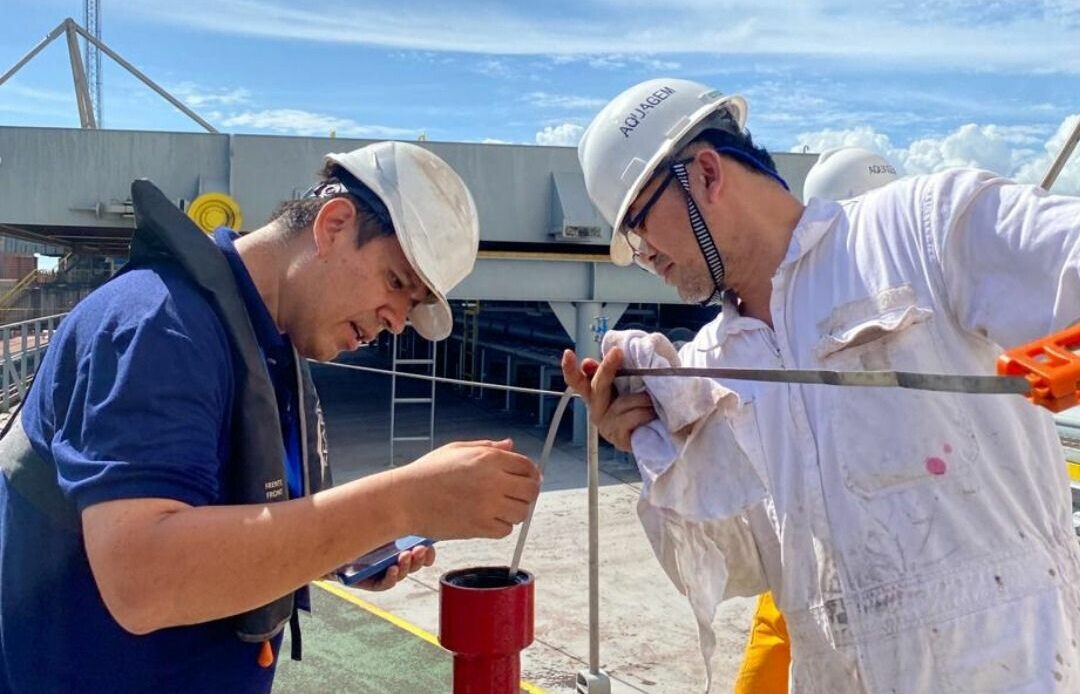
Poor documentation of where and when samples were taken
Not recording water temperature and instrument calibration
Robust surveys document density sampling location, timing, depth, temperature, and the hydrometer/thermometer used.
4) Tidal and Free Surface Effects Underestimated
Where relevant, tide and free surface corrections can materially affect results.
Typical shortcomings:
Not documenting tide stage at time of reading
Over-relying on forecasted tide tables without noting limitations
Not considering slack water vs strong current periods
Missing free surface corrections when tanks are slack
Even when tidal correction is not applied, the report should justify why and document prevailing conditions.
5) Ballast, Fuel and Consumables Not Accurately Accounted For
A draft survey is not only about drafts—internal weights matter.
Common failures:
Relying solely on ship’s declared ROB figures
Not checking sounding pipes accessibility or measurement feasibility
Not recording which tanks were sounded and which were assumed
Overlooking freshwater and lube oils as contributors
Good practice includes a clear list of measured tanks, assumed tanks and the basis used for each.
6) Hydrostatic Data Misuse
Hydrostatic tables and stability data must match the vessel’s condition and displacement range.
Issues that create disputes include:
Using outdated hydrostatic booklets
Applying incorrect TPC (tonnes per centimeter immersion) values
Confusing saltwater/freshwater references
Not identifying the source of hydrostatic data used
A strong report states precisely which hydrostatic source was applied and retains copies of calculation tables.
7) Weak Documentation and Incomplete Calculation Sheets
Even technically correct surveys can fail in disputes if documentation is poor.
Common documentation weaknesses:
No photos of draft marks or density sampling
Missing time stamps
No record of weather, swell, or current conditions
Calculation sheet not showing correction steps
Unclear units, rounding, or conversion methods
Claim-ready reporting depends on traceability: a third party must be able to follow the full logic from observation to result.
Practical Controls That Prevent Disputes
A dispute-resistant draft survey typically includes:
Multiple draft readings on both sides, recorded with times and conditions
Clear trim/list calculation method
Density samples documented by time, place, depth and temperature
Transparent treatment of tides and currents
Measured or justified ROB figures
Hydrostatic sources cited and attached
Photographic evidence and structured calculations
Conclusion
Draft survey disputes are rarely about the method itself—they are about execution quality and documentation discipline. In Brazil’s high-volume bulk environment, survey credibility depends on repeatable methodology, verified inputs and defensible reporting.
Independent marine surveyors reduce dispute exposure by producing figures that are technically sound and supported by evidence, allowing owners and charterers to settle quantity discussions with confidence.